It's nine at night. You were petting your cat, your fingers hit a hard clump behind her shoulder, and now you're standing in the kitchen with the good scissors in your hand doing the math on whether you can just snip it.
You can't. Put them back.
I run a grooming salon, and this is the one piece of at-home cat advice I'd tattoo on something if I could. Not because owners are careless — the people who reach for the scissors are, without exception, trying to help a cat they love who seems uncomfortable. It's because of a specific, genuinely unintuitive fact about how cat skin behaves, and once you know it you can't unknow it.
Why the Scissors Look Like the Obvious Answer
The logic is completely reasonable. There's a lump of tangled fur. Fur is not attached to anything important. Scissors remove fur. The cat is annoyed by the lump, you are annoyed by the lump, and there's a pair of scissors in the drawer.
The reason this reasoning fails has nothing to do with your steadiness of hand. It's that the premise is wrong: the mat isn't sitting on your cat. It's holding onto her.
What's Actually Under That Mat
A mat forms when shed fur that never made it off the cat tangles into the live coat and compresses. As it tightens, it doesn't just get denser — it pulls. And cat skin is thin, loose, and mobile in a way dog skin isn't. When a mat contracts, it lifts a tent of skin up into itself.
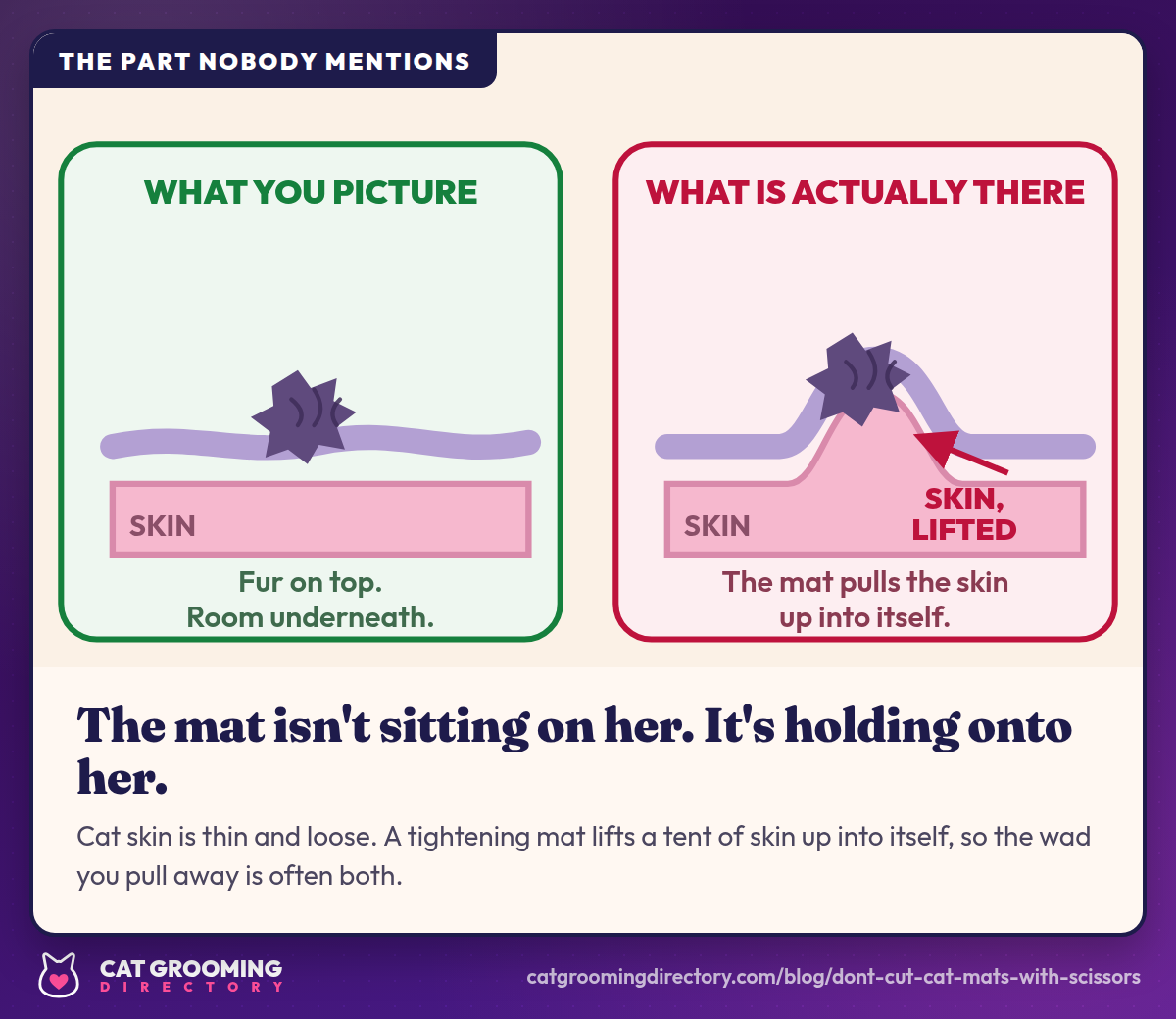
Which means that when you take hold of a mat and pull it away from the body to get a blade underneath — the exact, instinctive motion everyone makes — you are very often lifting skin along with it. It doesn't feel like skin. It feels like a wad of fur, because there's a wad of fur wrapped around it.
Add the second variable: the cat. Cats do not hold still on request. They hold still right up until the moment they don't, and the moment they don't is usually the moment something pinches. The ASPCA's guidance on matting says it plainly — never cut mats out with scissors, because your pet can move or jerk unexpectedly and the result is a severe laceration or puncture.
That's the whole mechanism. Skin you can't see, in a spot you can't feel, attached to an animal with strong opinions about being restrained. Groomers use clippers laid flat against the body rather than scissors for exactly this reason: a clipper blade slides between coat and skin, while scissors close on whatever is in the gap. That close clipper work isn't risk-free either — clipper burn is a different, much smaller risk than a scissor cut — but it's one a trained groomer manages routinely, not a coin flip.
If you want the wider picture of how mats form and where they show up first, our full guide to matted cat fur covers the map. Tonight, though, the only thing you need is the part above.
Mats Are a Health Problem, Not a Grooming Problem
I want to be clear that "don't cut it" isn't the same as "ignore it." Mats genuinely matter, and that's precisely why the removal needs to go right.
The same ASPCA guidance, from ASPCA veterinarian Dr. Julie Horton, is blunt about the progression: even very mild mats can cause skin irritation and progress to infected lesions. Fleas and ticks can live deep inside a mat, out of sight, and infest the animal. And more severe mats can become strangulating wounds — the mat grows around a limb in a circumferential way and cuts off the blood supply.
So the mat is a real problem on a real clock. It's just a slower clock than it feels like at nine at night. A mat that's been forming for three weeks is not going to turn into an emergency between now and your groomer opening tomorrow. A laceration will absolutely turn into an emergency tonight.
That's the trade the scissors are asking you to make, and it's a bad one.
What To Do Tonight Instead
Here's the actual list, in order, and it's shorter than you'd think because most of it is restraint.
Stop working the area. Not just the scissors — stop brushing at it too. Repeated attempts on a tight mat pull the skin underneath over and over, and by the time your cat is sore, she's also learned that your hands mean discomfort. That's a second problem you'll have to un-teach later.
Don't bathe her. Water tightens mats, dramatically. A clump that might have combed out dry can shrink into a solid skin-tight sheet once it's wet. Mats come out before the bath, never during it.
Don't pull, tease, or "just work it loose." The base of the mat is anchored to skin. Tugging tears at that anchor point, and even when nothing visibly breaks, it hurts more than the mat did.
Map the coat instead of fixing it. Run your hands over the whole cat, gently, and note where the clumps are. Armpits, behind the ears, the britches, the belly, under the collar, and the base of the tail are the usual suspects — anywhere that rubs. Knowing you have four mats instead of one changes what you tell the groomer and what they book you for.
Keep the evening normal. Feed her, let her settle, don't turn tonight into an ordeal. She's been carrying this mat for a while already.
Call in the morning, and use the word "matted." This one matters more than owners expect. A matted cat needs a longer slot, sometimes a different groomer, and occasionally a different plan entirely. A salon that finds out at drop-off has to either rush the work or send you home, and neither is a good outcome. Say it on the phone.
Go sooner than tomorrow if the skin is talking. If the skin around the mat is red, weeping, hot, smells off, or your cat reacts sharply to light contact, that's not a scheduling question anymore — call your vet. Same if the mat has wrapped a leg or the tail. Those are the situations the ASPCA is describing, and they belong with a vet rather than in a grooming chair.
If You Already Cut Her
Some of you are reading this after the fact. That's fine, and it's more common than the internet lets on.
Call your vet, today. Don't keep clipping to "even it out," don't put anything on it from the human medicine cabinet, and please don't try to judge how bad it is by how it looks — because of that same thin, loose skin, these wounds are routinely deeper and longer than the opening suggests, and the tissue separates under the surface where you can't see it.
I'm not going to walk you through wound care, because that's a veterinarian's job and not mine. The only thing I'll say with any confidence is the part people actually need to hear: you will not be the first person to make this call, nobody is going to lecture you, and calling immediately is what turns it into a small story instead of a big one.
🐾 Looking for a cat groomer near you?
Browse trusted groomers in Houston, TX or San Francisco, CA — or jump to our full Devon Rex grooming guide if you have one at home. Every listing on the directory is local and actively serving clients.
Where the Mats Came From, So This Doesn't Repeat
Once the coat is sorted, the useful question is why it happened, because mats are almost always a symptom of something rather than a random event.
The coat did it. Long and medium coats with dense undercoat mat because there's more shed fur that never leaves. Persians, Himalayans, Maine Coons, and Ragdolls sit at the demanding end of the coat spectrum — if that's your cat, our guide to Persian matting specifically gets into the routine that actually holds a coat like that together.
The season did it. Late summer is a quietly bad stretch for matting. Humidity plus the tail end of the summer coat plus the first hint of the fall shed means loose fur sitting in a coat that's damp more often than usual. It catches out the people who got through the entire spring shed without a single tangle and assumed they were clear.
The cat stopped doing it. This is the one worth paying attention to. A cat who used to keep herself immaculate and suddenly can't is telling you something. Cornell's Feline Health Center notes that older cats groom themselves less effectively, which can result in matting, skin odor, and inflammation — and that an older cat's skin is thinner, less elastic, has reduced circulation, and is more prone to infection. Weight, arthritis, and dental pain all interrupt grooming the same way. If your cat's coat changed before the mats appeared, a cat who stops grooming herself is worth a conversation with your vet, not just a brush.
None of these are your fault. All of them are fixable once you know which one you've got.
When to Call a Professional Groomer
The line is genuinely simple, and it's the same test in every case: can a comb pass between the clump and the skin?
If yes, it's a tangle. You have time, you can work it out gently from the tip inward, and consistency will beat it.
If no — if it's flat and tight and moving it moves the skin — it's a mat, and it's a booking. Same answer if there are several, if they're on the belly or the britches, if your cat won't tolerate you touching them, or if she's a senior with fragile skin.
A groomer working on a matted cat isn't doing a fancier version of what you'd do at home. They're clipping under the mat with a blade against the skin, checking what's underneath as they go, and stopping when the cat has had enough. Our guide to what to look for in a groomer who handles matted cats covers the questions worth asking, and if the coat has gone past saving, the lion cut decision walks through what a full reset costs and how long it takes to grow back.
Finding Someone Who Actually Does This
Matted cat work is a skill, not a service line. It's slow, it's physical, and plenty of salons don't take it on — which is fair of them, and also why "my usual place said no" is such a common start to these phone calls.
Every listing in our cat grooming directory is a groomer who takes cats, searchable by where you live. It's free for cat owners and always will be. Search your city, call two, say the word "matted" in the first sentence, and ask how they'd handle it. The ones who do this work will have an immediate, specific answer.
Then book the follow-up before you leave. The thing that most reliably keeps you out of your kitchen with a pair of scissors again in four months is an appointment already sitting on the calendar.
Common Questions
Can I cut my cat's mats out with scissors? No. The ASPCA's guidance is direct about this — you should never cut mats out with scissors, because a pet can move or jerk unexpectedly and the result is a severe laceration or puncture. The specific problem with cats is that a mat doesn't sit on top of the skin, it pulls the skin up into itself, so the thing you're lifting to cut is often skin and coat together. If a mat can't be brushed out, the ASPCA's advice is that the cat should see a groomer or a veterinarian who can clip it out safely.
How do I know if it's a mat or just a tangle? Slide a comb, or a finger, between the clump and the skin. If it goes underneath easily, you have a tangle and you have time. If it won't pass — if the clump is anchored flat against the body and moves the skin when you lift it — that's a mat, and it's a booking, not a project. Tight against the skin is the line.
Why can't I just bathe the mat out? Water tightens mats. A clump you might have worked loose while dry can shrink into a solid, skin-tight pelt once it's wet, and now it's worse and your cat is also soaked and furious. Mats come out before a bath, not during one, which is one of several reasons the bath isn't the fix people hope it is.
I already cut my cat and the skin is open. What do I do? Call your vet, today. Don't clip further, don't clean it with anything from the medicine cabinet, and don't try to judge the depth by looking — cat skin is thin and loose, so these injuries routinely look smaller from the outside than they are underneath. This is a vet call, not a home-dressing situation, and it isn't a call anyone will make you feel bad about.
What can I safely do about a mat at home? For a genuine tangle that a comb still passes under: hold the base of the fur against the skin so nothing pulls, and work from the tip inward, a little at a time. Stop the moment your cat flinches, vocalizes, or turns toward your hand. For anything tight to the skin, the safe home move is nothing at all — leave it alone and book it. Mats get worse slowly, so one more night doesn't hurt. A cut does.
Will a groomer judge me for letting the coat get this bad? A good one won't, and the ones who do aren't worth booking. Mats show up on senior cats who can't twist anymore, on overweight cats who can't reach their own back half, on cats going through a bad shed, and on cats who quietly stopped grooming because something hurts. None of that is neglect. The groomer's actual reaction is usually relief that you called before it got to a full pelt.
Your cat has survived this mat for weeks and will survive it one more night. The scissors are the only part of this that can't be undone.
Frequently Asked Questions
Courtney
Cat grooming expert and contributor to Cat Grooming Directory. Passionate about helping cat owners find the best grooming solutions for their feline friends.